By: Abdirahman Aynte
Fellow, The Center for Independent Media
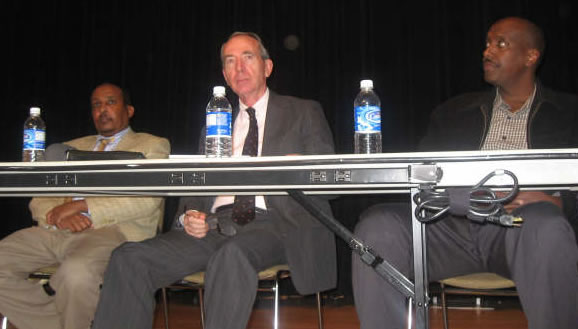
Minneapolis, MN (HOL) - When David Shinn, a former U.S. Ambassador to Ethiopia, gives a keynote speech Saturday at a St. Paul forum on Somalia, wary-looking Somalis listen earnestly as he and other panelists embark on possible solutions to Somalia’s decade and half-long plight.
Shinn, a Horn of Africa guru at George Washington University was hosted by the Minneapolis-based Somali Institute for Peace and Justice (SIPJ), a novice think tank that hopes to study Somalia problems and offer recommendations.
Somalis are alerted by recent developments in their country, where forces of the weak, but internationally recognized Transitional Federal Government (TFG), and the powerful Union of Islamic Courts (UIC) are feared to engage in an all-out civil war that might destabilize the Horn of Africa region.
That’s because neighboring Ethiopia and Eritrea, who fought in a deadly war over unresolved border dispute, are thought to be fueling the tension in Somalia. The U.S. warned a proxy war there.
A recent U.N. report estimates that Ethiopia has more 8,000 troops in Somalia, while Eritrea has a quarter of that, all in violation of a 14 year-old U.N. arms embargo.
Shinn said: “Somalis alone should resolve their problems,” and “non-Somalis should end their unjustified interference.”
Ethiopia, he said, has a legitimate security concerns, because it doesn’t want a hostile neighbor that might reclaim the Somali inhabited region in Ethiopia. “Ethiopia wants a strong, united, but friendly Somalia,” he said.
Most Somalis dispute that, saying that all Ethiopia wants is the exact opposite.
Shinn added that former members of Al-Ittihad Al-Islamiya, a now defunct organization branded by the U.S. and Ethiopia as a terrorist entity, are now prominent figures in the UIC. That not only worries Ethiopia, but U.S. intelligence agencies conclude that the three masterminds of the 1998 bombings of U.S. embassies in Kenya and Tanzania, are hiding in Somalia, potentially under the auspices of the UIC.
Whether that’s true or not, Shinn admits that the Ethiopian military presence in Somalia is a recipe for Jihadist elements to easily recruit fighters. And “that’s not in the interest of the U.S.,” he said.
Even the proposed “peace-support mission” by IGAD, a union of neighboring countries, “is ill-advised,” Shinn said.
He also criticizes the U.S. government for neglecting Somalia since the hasty withdrawal of American troops from the African nation in 1994. The current refocus, he said, is un-pragmatic, because it ‘s sole prism is fear of terrorism. The U.S. aid to Somalia, hence, has plunged significantly, according to Shinn.
Future U.S. Role
In light of the recent peace talks between the TFG and UIC, which stalled in October after the two sides took uncompromising positions, the U.S. should take a leading role in reviving those talks, Shinn said. “The U.S. should also support the informal talks in Mogadishu.” He was referring to the speaker of the parliament’s unilateral peace mission in Mogadishu, swiftly rejected by the prime minister.
One critical role for the U.S. is helping enforce the U.N. arms embargo on Somalia, which’s routinely violated by neighboring nations, Shinn said. “A special envoy with ambassadorial capacity would’ve been able to engage in neighboring countries,” he said. “We don’t even have that right now.”
The U.S. government has good relations with TFG, but Shinn says that “we should equally engage the UIC.” Isolating them, he argues, makes them prone to befriend with our enemies.
Abdirahman Aynte can be reached at [email protected]
Source: HOL, Nov 13, 2006