
Tuesday, November 14, 2006
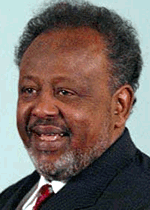 DJIBOUTI, Nov 14 (AFP) - Djibouti President Ismael Omar Guelleh on Tuesday lamented the worsening situation in Somalia, but called for serious dialogue between feuding leaders to avert an all-out war.
After the failure of previous talks between the weak government and the powerful Islamist militia, Guelleh said there was little hope that the prevailing climate in Somalia could achieve a lasting peace.
"We are trying to solve the problem through negotiation. Africa has put mechanisms in place to solve such problems through the African Union and its Peace and Security Council," Guelleh told AFP in an interview.
Somalia has lacked a functioning authority since the 1991 ouster of strongman Mohamed Siad Barre and the two-year-old transitional government, formed in Kenya, has been unable to assert control.
Instead, it has been wrangling with the Islamists, who ousted warlords in June and are currently expanding their territory beyond south and central Somalia while imposing Sharia rules.
Earlier this month, the latest round of peace talks between the government and the Islamists in Khartoum failed, heightening fears of an all-out conflict that could engulf the entire region.
Previous truce and mutual recognition pacts have been violated.
Guelleh, whose government helped form a failed government in 2000, blamed foreign interference for the failure of more than 14
internationally-backed initiatives to restore peace and stability in the shattered African nation.
"Do we lack the courage, means and partners of Somalia? I do not know, but we have been unable to establish a team that can inspire the confidence of the people and the respect of the international community," he said.
"Each time there are external and internal factors that come into play, to impose their ulterior interests and each time we failed," Guelleh said, apparently referring to neighbouring states that have been accused of meddling.
"Now there is a new effort, we are trying to bring the Islamists and the transitional government together so that they solve the problem once and for all, but this too has not worked," he lamented.
Ethiopia denies having thousands of soldiers in Somalia but acknowledges sending military advisors to help protect the government from "jihadists," some of whom are accused of links with Al-Qaeda.
Tension has soared in Somalia after the talks collapsed on November 1 renewing fears of a full-scale war that diplomats and analysts fear could draw in Ethiopia and Eritrea.
Many believe the two countries may have turned Somalia into a proxy battlefield for their own unresolved 1998-2000 border war.
Eritrea has been accused of supplying weapons to the Islamists in Somalia but has hotly rejected allegations it has sent some 2 000 soldiers to back them.
Source: AFP, Nov 14, 2006