|
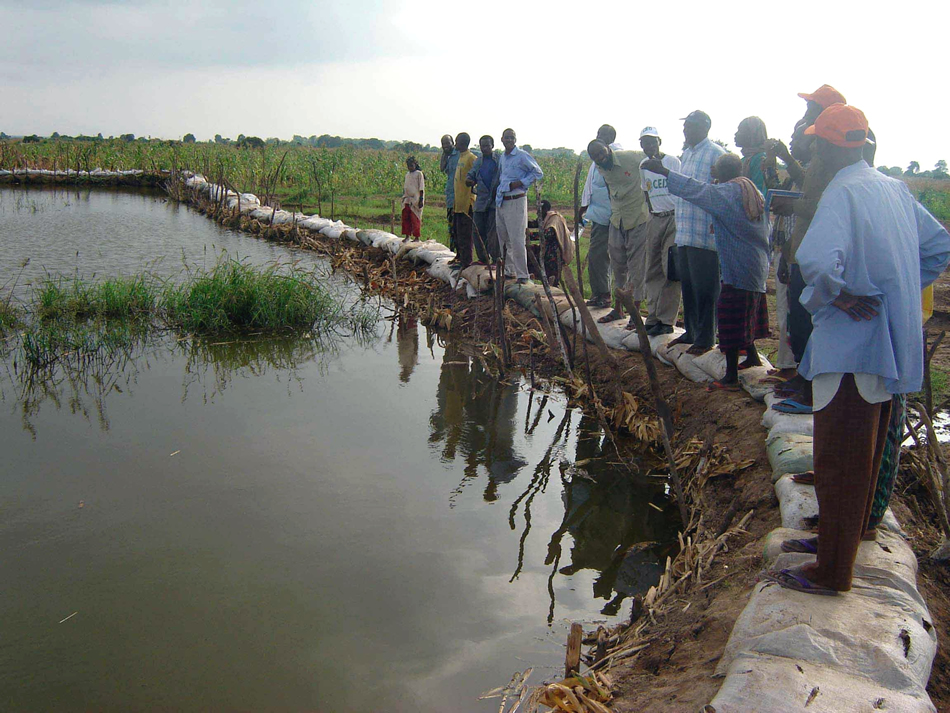
Villagers embank flood water in middle Shabelle region, Somalia. |
MOGADISHU, 30 Nov 2006 (IRIN) - Madey Ali was one of five men trying to rescue an old woman from the jaws of a crocodile when he was swept into the reptile-infested waters in Balad district of Somalia’s Middle Shabelle region.
"Madey Ali tried to swim across the river," his cousin Osman Shiiqow said on Tuesday. "As he was crossing the river, a crocodile appeared and took him."
The 45-year-old family man was desperate to locate his four wives and children, who had been separated from him in the rush to escape raging flood waters. But as soon as Madey realised the crocodiles would eat the old woman, he called his four friends and they plunged in to attempt a rescue.
"We could do nothing except to climb the nearby trees to save ourselves," Shiiqow added.
Health risks
According to the United Nations, those affected are also facing problems of disease from overflowing latrines and hunger. The World Health Organization (WHO) said the hygiene and sanitation conditions in the affected areas were threatening an increase in communicable diseases. In Hiran, for example, 70 percent of latrines have been destroyed. "The number of diarrhoeal cases in the flood-affected areas is on the increase and cholera has been confirmed in Jilib district in Middle Juba," the agency said on Wednesday.
"Health facilities in the flood-affected areas have been disrupted with damage or loss of equipment, supplies and vehicles," WHO added. "Service providers and patients are facing difficulties in accessing health facilities as roads have been cut off by the floods."
The flooding started when Juba and Shabelle rivers, which flow from the Ethiopian highlands, swelled after heavy rains and burst their banks in October. Nearly 400,000 people have been affected by the surging waters, which have also inundated farmland, especially in Lower Juba, particularly around the towns of Buaale, Jilib and Jamaame. This number is expected to rise to 900,000 if rains continue up to January 2007, as predicted by some analysts.
"It is a huge humanitarian crisis," Eric Laroche, UN Humanitarian Coordinator for Somalia, said last week, adding that US$15 million or more would be required for the flood emergency in Somalia, depending on how severe the situation becomes.
Unsafe water
Residents are terrified that even if the water level goes down, they will continue to suffer from the impact. "We are at risk - either from the water or the crocodiles," Hajiya Madina Harun, a resident of one submerged village, said. "Apart from diseases, we also don’t have food or mosquito nets and we are weak."
To cope, villagers say they sometimes climb trees to keep safe from possible attack by crocodiles and eat the leaves for food. But it is the pungent smell of decaying debris that makes it even tougher to live in the villages. "The flood water is badly contaminated," said Haji Hassan Ahmed Add, manager of a local rescue committee organised by the Union of Islamic Courts, which controls much of southern Somalia. "It has an offensive odour and is full of worms, larva, maggots and other insects. I am afraid this will cause future problems."
Mohamed Bocor Omar, the community health officer of Balad, said fears had grown that the affected people may face long-term environmental problems. "The people are trapped in areas where the inhalation of contaminated oxygen will cause them health difficulties. The rescuers are also facing problems when they work two or three days in the area because the air is not clean."
At the Jameco Misra river intersection where the Damaley and Muki Dhere rivers meet, 25 km from Balad district, people have stopped using the river water. For a very wide area there is a foul smell that gives people headaches and makes them cough.
"The tragedy is widespread," said Abdullahi Ali Hassan, director of the Center for Education and Development, an NGO that is providing emergency relief in the villages around Balad. "I am afraid there will be future problems if people don’t get a quick response to save them from the contaminated flood water."
Latest forecasts show the rains eased last week, especially in the mid- and head-water areas of the Jubba and Shabelle River Basins, but flooding remains a serious threat in areas towards the coast as water continues downriver. Experts say there is also a threat of heavy rains in head-water areas of the Shabelle River over the next week, as well as in the lower Jubba Basin, increasing the likelihood of flooding in these areas.
The UN is planning to launch an appeal for about US $12 million to support the work of various agencies and NGOs trying to help those affected.
ak/mw
[ENDS]
Source: IRIN, Nov 30, 2006