
A struggle to keep people and hope alive
Oct. 22, 2006
DADAAB-No one dies here.
With the sheer number of refugees threatening to overwhelm this camp by the end of the year, the United Nations Humanitarian Commission of Refugees (UNHCR) is appealing for help.
This camp opened in 1991 after former Somali president General Mohamed Siad Barre and his government were overthrown by rival clans. In the 15 years since, Somalis have fled famine, floods and the anarchy caused by battling warlords.
But now a group of powerful Islamists with the Union of Islamic Courts have taken over much of southern Somalia, and its strict adherence to sharia law is drawing comparisons to the Taliban.
While their authoritarian rule has brought a measure of order, there are fears Somalia may become the West's next target in the ongoing fight against terrorism. Ethiopian troops have reportedly positioned themselves inside Somalia to support the UN-backed transitional federal government. Meanwhile, Eritrea faces accusations of shipping arms to the Islamists.
Now, with fears that the two old rivals will start fighting on Somalia's soil and skirmishes breaking out as the UIC expands its control, Somalis are fleeing in unprecedented numbers.
And frustration here is growing among both long-time residents unable to seek refuge abroad and new arrivals waking to the possibility that this could be their home for years.
Somali passports are not internationally recognized, making it particularly difficult to resettle these refugees. The best hope for most is to return one day to Somalia — but peace in one of the most anarchic countries in the world seems elusive.
"They have had enough here," says UNHCR camp director Nemia Temporal. "We need to keep the hopes of people alive — the hopes to return, because that's all they hang on to for now."
Many of the lucky few who do leave go to Toronto, believed to be home of the largest Somali diaspora outside of Africa. Statistics of the actual population vary, but most believe there are more than 100,000 Somalis now calling Toronto home.
And the ties that bind Canada to Somalia are strong. Some Somali-Canadians have returned home to try and help with the country's transformation. A former Toronto grocer is now one of the Islamist leaders, and several Canadians hold positions within the cabinet of the transitional government.
During a recent visit to the camp by the Star, many spoke of their Canadian relatives, and a few asked for help in joining them.
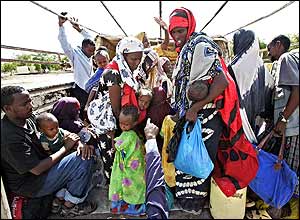
It's a plea Canadian Karin Michnick will hear often as the camp's new resettlement officer. After leaving a job with Canada's Immigration and Refugee Board, Michnick arrived a month ago to take on the daunting task of trying to find placements for the refugees, some of whom have never known another home. Among those who weren't born here, many spent weeks travelling most of the way to the camp on foot. On one day during the Star's recent visit, about 685 refugees arrived after having walked across a Somali-Kenyan border marked only by truck tire tracks in the sand and a concrete post obscured by a thorn bush. Most refugees come from Mogadishu, Kismayo or Baidoa.
Mogadishu may be experiencing unprecedented security now under the Islamists, but strict rules that include floggings for women who aren't properly covered and public execution of criminals have sent many running from their homes.
Some residents of the port city of Kismayo, meanwhile, fled after the Islamists' young militia seized the town. The takeover was led by two previously elusive Somalis — Hassan Turki and Aden Hashi Ayro — listed by the U.S. and UN as supporters of terrorism and with alleged connections to Al Qaeda. Refugees reported that protests against the pair's rule in Kismayo were violently suppressed.
The remaining refugees came from Baidoa, 250 kilometres from Mogadishu, where the UN-backed transitional federal government is based. They saw Ethiopian troops arrive after a suicide-truck bombing narrowly missed the transitional government's president but killed his brother and several others last month. Ethiopia still refutes claims that it has any troops inside Somalia.
The camp actually consists of three individual compounds run by a small UNHCR staff numbering no more than 50 along with a handful of other organizations stationed here, including CARE. Standing guard around the camp's edges are massive marabou storks. Their predilection for eating garbage and then squirting excrement on their own legs make them the most despised inhabitants of this place. Lions and hyenas have also reportedly snuck into the camp at night and attacked the children.
Since Dadaab is about 100 kilometres from the border, refugees first arrive at an outpost in Liboi, where they're registered in what can only be described as a system of organized chaos.
A long line of children snakes into a cloth tent for vaccinations. The mothers then register the family with the UNHCR and CARE staff wearing yellow shirts with the message: "Protect rights of young girls. Don't circumcise them." The overwhelming majority of refugees are women and children.
UNHCR trucks used to come to Liboi one or twice a week to transport refugees through the arid landscape, where pairs of tiny antelope-like animals call dikdiks scatter with the sound of the convoy. The arduous journey can sometimes take more than three hours, and now the trucks make it every day.
Zaynab Mohammed Ahmed came here from Mogadishu in her pink plastic flip flops, her arms empty of possessions, her hands no longer clutching those of her children. She said she fled after her husband was killed on the streets of Mogadishu and her two young children disappeared. Recalling that day, when she believed her 6- and 7-year-old were safer alone at home than at the market where she went to shop, Ahmed can hardly speak through her tears.
"I came home and they were gone. If I can't find my children I have no life."
She searched for 30 days before walking here, hoping to get news of their fate or discover they had fled with others.
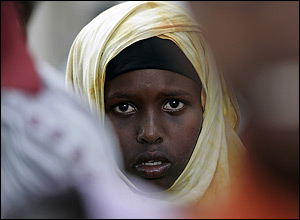
Khadra Mohammad Hussain arrived alone from Kismayo, separated from her relatives in the chaos of the exodus that followed the Islamists' takeover. The 18-year-old sat nervously under the shade of a tree, speaking softly to some of the older women.
A few paces away, 14-year-old Khadija Hassan Aden was also on her own. Her parents had died long ago, so her grandparents raised her. But then they died too — and she found herself here.
Others arrive at this refugee camp with the physical scars of what they're running from. Arms and legs have been amputated after gunshots shattered bones. Others lost their limbs because of infections that developed in improperly treated wounds.
One man displays an impossibly deep crater in his forehead; another nurses a deformed ankle swollen to 10 times its original size.
The Kenyan government's rules for the camp forbid refugees from working. In the past it has shut down entrepreneurial projects, arguing that they might draw business from nearby towns. But still, with such a large population, the Dadaab camp functions as more of a town than a refugee camp.
A generation of children have been born here and knows no life other than the shacks made of sticks, plastic and garbage where they sleep.
They eke out an existence that, despite Kenyan government restrictions, somehow includes a market that sells everything from televisions to khat (a green leafy plant that acts as a powerful stimulant when chewed and is wildly popular in Somalia). UNHCR workers say they don't know how the goods come in or go out, but the market boasts competitive prices that draw customers from outlying regions.
Dadaab's hospital, which consists of several wooden shacks and a birthing room with a metal table whose leg holsters are starting to rust, houses some of the children recovering from the long, hot journey to the camp.
Here lies severely malnourished, five-month-old Halima Ahmed. Her mother fled from the port town of Kismayo after last month's takeover. The tiny girl's sunken chest is scarred along the ribs with burn marks from a local healer who'd tried to cure her shrivelled state. The hospital doctor says the baby arrived just in time to be saved.
The camp's newest arrival lies swaddled in a crib beside his mother, who just underwent a Caesarean and is being fanned by two women as she begins to stir from the anaesthetic.
There are fears of health risks as the camp moves towards its capacity. The alarming diagnosis last week of polio in a 3-year-old girl — the first such diagnosis for Kenya in 22 years — was regarded as a serious setback in the global effort to eradicate the disease.
There's also concern that the conflict engulfing Somalia will be imported here. A 6 p.m. curfew sends UNHCR and other non-government staff to their guarded compounds, leaving the refugees somewhat vulnerable to outside trouble for 12 hours. One of the biggest fears is that the camp is ripe for recruitment by the forces now fighting inside Somalia.
While Somalia has always been deeply divided along clan lines, now, with two distinct factions — those backing the Islamists and those on side with the transitional government — lines may be drawn here in the camp as never before.
"We have to really carefully ensure whatever they do in Somalia is not mirrored here," says camp director Temporal.
During a recent camp celebration to mark a day devoted to refugees worldwide, a group of new arrivals performed a play in which they re-enacted their escape from the Islamists who took over their town. While the performance was well received at the time, UNHCR staff later learned that the performers were beaten for their negative portrayal of the Union of Islamic Courts.
If there's hope to be found in a place largely devoid of it, it's within the tin walls and wooden roofs of the camp's school.
In one classroom, eight beaming boys raise their hands excitedly and wiggle their fingers. "They're clapping for you," their teacher explains. "They're deaf. This is how they clap."
One of the boys will write his Grade 8 exams in accordance with the Kenyan curriculum. He says he'd like to get to university.
The school boasts 50 teachers, five of whom are female, and offers classes ranging from AIDS education to math and science.
Most of the children aspire to join the few students whose education carried them away from here. At least five have won scholarships to Canadian universities.
Two, says the school's proud director, are now studying at Princeton.
advertisements
Not officially anyway. Death in this overcrowded refugee camp for victims of Somalia's civil wars means a family loses one of its precious food-ration cards, so the bodies of the old and sick are quietly taken in the night and buried in the sandy soil.
The graves, marked only by a slight bump in the earth and a few sticks, go unrecognized by visitors as the camp's makeshift cemetery.
It's hard to determine just how many refugees live here in Kenya's remote eastern zone, near the Somali border, but a safe estimate is about 150,000, with hundreds more arriving every day. A few travel from Sudan, Uganda and Ethiopia, but the overwhelming majority come from Somalia.
 | ||
|
|
 | ||
|
|
Related Link
Video: Scenes from Somalia (Low bandwidth)
Video: Scenes from Somalia (High bandwidth)
Mogadishu: The Canadian connection (Oct. 21)
In Photos: Radical Mogadishu
Michelle Shephard in Mogadishu (Oct. 20)
Source: Toronto Star, Oct.22, 2006