By Abdirahman Aynte
The Center for Independent Media
It’s his newest work in a trilogy called “variations on the theme of African dictatorship.” Farah’s fictions depict the lives of Somalis, particularly women, who sustained the bulk of
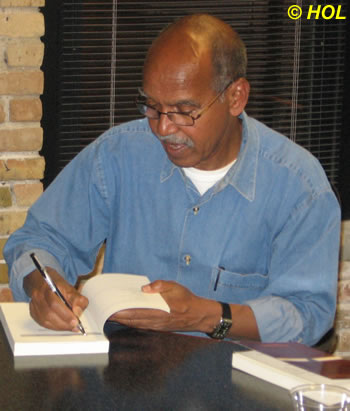
“A prolific writer” is how he was introduced. At 62, he looks a bit frail. His hair is almost entirely gray. He’s a deliberate speaker who yearns for an unparalleled attention when he potently commences to read from his works.
 |
|
Nuruddin Farah is the winner of the 1998 Neustadt International Prize for Literature. He is the author of eight novels, including, most recently, Knots. |
This’s why some people call Farah a feminist. He dodged a question about that and went on to lambaste Somali men for being “armchair worriers,” locally known as “Fadhi ku dirir.”
And then he began glowing Somali women for not only taking the brunt of the civil war damage, but for rescuing innumerable Somali families while men chew Khat and financed conflicts in Somalia.
But then Farah ventured into an uncharted territory. He disparaged Somali women for veiling, drawing the indignation of many. He blamed men for coercing women to wear “non-traditional clothes.” He asked “Can’t we fear Allah without this Afghani business?” He was referring to the all-enshrouding cloak worn mostly by women in
Hissing was the new humming. To many women in the audience, Farah was no longer the virtuoso they pierced the frigid weather just to take a glance at him. A young woman, who was not veiled, challenged Farah. “The Hijab,” she said, “is a private matter between people and their God. Many times it’s a way of healing.” Farah interjected “but you’re not wearing it!” Another young woman, who was sandwiched in a tiny space, whispered to my ear “he’s no longer striking a chord with me—another Somali secular.”
Indeed, Farah is a self-described secular. In an interview with Minnesota Public Radio early this week, he said he visited
But a man in the audience asked him why he wouldn’t continue that effort by writing a book supporting the TFG. Farah, who shuns politics, said that he “supports peace.” Another sobbing young woman wanted him to talk about the plight of Somali youth.
Asked who inspired him to become a writer, Farah mentioned Ismail Buubaa, the current foreign minister of the TFG and the late Adan Jama Bihi. The latter offered to edit Farah’s first book.
In 1998 Farah won the prestigious Neustadt International Prize for Literature. He was nominated for Nobel Prize in Literature several times. He lives in
Abdirahman Aynte can be reached at [email protected]