
SALAD DUHUL Associated Press Writer
Thursday, January 18, 2007
 |
|
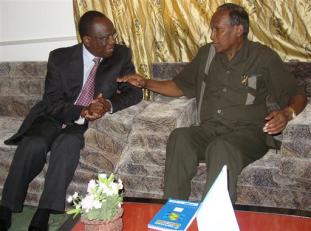
The U.N. Secretary General's special representative to Somalia, Francois Lonseny Fall, left, has discussions with the Somali President Abdullahi Yusuf, Thursday, Jan. 18, 2007 in the capital Mogadishu. A top U.N. envoy said on Thursday that Somalia's government needs protection following its relocation to the capital after ousting an Islamic movement that had held Mogadishu for six months. (AP Photo/Mohamed Sheikh Nor)
MOHAMED SHEIKH NOR: AP |
Francois Lonseny Fall, the Secretary General's special representative to Somalia, met with President Abdullahi Yusuf for the first time in the capital, where Somali troops took over last month with the help of Ethiopian troops.
"To see the president in Villa Somalia (the official residence of Somali presidents) is a very important step. We have to move step by step and we need all efforts to get this country rebuilt," Fall said before his closed-door talks with Yusuf.
Emerging 30 minutes later, Fall said that now that the government was installed in Mogadishu, "we need to protect them and also facilitate the withdrawal of Ethiopian troops. This is what everyone expects."
The potential for violence may be dissuading many countries from committing soldiers. A U.N. peacekeeping force that included American troops met disaster in Somalia in 1993, when militiamen shot down two U.S. Army Black Hawk helicopters and killed 18 U.S. troops.
On Wednesday, Prime Minister Ali Mohamed Gedi ruled out peace talks with the Islamic movement and expressed a desire to see the first African peacekeepers in Somalia by month's end. Ethiopia has said it can't afford to keep its troops in Somalia much longer.
There has been sporadic fighting since the government took over Mogadishu on Dec. 28. Leaders of the Islamic movement have pledged to carry on a guerrilla war as long as Ethiopian troops remain.
A day earlier, the Somali parliament stripped the speaker position from a top lawmaker who was closely associated with the Islamic movement, formally known as the Council of Islamic Courts.
The United States and the European Union said Wednesday's vote to fire Sharif Hassan Sheik Aden as speaker could hurt reconciliation efforts in the restive country. They said Aden was capable of pulling together moderate elements among the Islamists.
Aden had made several freelance peace initiatives with the Islamic Courts before Ethiopian-backed government forces ousted them in December from the capital, Mogadishu, and much of southern Somalia.
Somalia has not had an effective central government since 1991 when warlords overthrew longtime dictator Mohamed Siad Barre and then turned on each other, reducing this Horn of Africa nation to anarchy and clan-based violence.
___
Associated Press writers Mohamed Sheikh Nor and Mohamed Olad Hassan in Mogadishu and Malkhadir M. Muhumed in Nairobi, Kenya, contributed to this report.
Source: AP, Jan 18, 2007