
Wednesday November 26, 2025
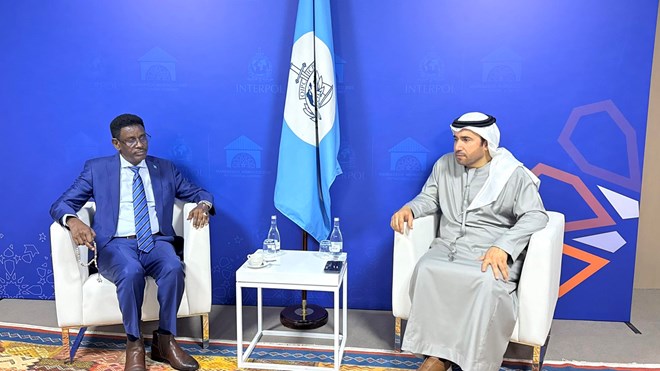
Somalia’s Minister of Internal Security, Abdullahi Sheikh Ismail Fartaag, left, meets with Interpol President Ahmed Nasser in Marrakech, Morocco, on Wednesday during the 93rd Interpol General Assembly. The two discussed enhancing cooperation on counterterrorism, organized crime, and law enforcement capacity-building. (CREDIT / SONNA)
Mogadishu (HOL) — Somalia’s Minister of Internal Security, Abdullahi Sheikh Ismail Fartaag, met with Interpol President Ahmed Nasser on Wednesday in Marrakech, Morocco, to discuss expanding cooperation on cross-border crime, counterterrorism, and access to global security intelligence.
The discussion took place on the sidelines of the 93rd Interpol General Assembly, an annual gathering of security officials from more than 190 member countries. The meeting focused on strengthening Somalia’s law enforcement capabilities through enhanced data sharing, technical training, and cooperation against organized crime, human trafficking, cybercrime, and terrorism.
advertisements
Officials said the Somali delegation stressed the importance of integrating its security agencies with Interpol’s databases to better track suspects, monitor financial crimes, and prevent extremist movements across borders. Somalia has been working to modernize its policing and border security as part of wider efforts to stabilize the country and counter al-Shabaab.Minister Fartaag thanked Interpol for its role in strengthening international security systems and reaffirmed Somalia’s commitment to working closely with global partners. He said international cooperation is critical for countries facing persistent threats from transnational criminal networks.
Somalia has been a member of Interpol since Oct. 9, 1975, but decades of civil war and state collapse severely undermined its law enforcement and institutional capacity. As the country began rebuilding its federal institutions, Interpol reemerged as a critical partner in restoring policing functions and reestablishing international law enforcement cooperation.
That partnership has expanded in recent years. In June 2025, Somalia’s Immigration and Citizenship Agency signed a Memorandum of Understanding with Interpol to strengthen border and travel security, improve training for immigration officers, and boost the country’s ability to combat organized crime, human trafficking, and other transnational threats.
Interpol President Ahmed Nasser praised Somalia’s progress in improving its security institutions and pledged to increase technical support, including law enforcement training and expanded access to international policing tools.
The 93rd General Assembly in Marrakech is addressing new global security threats, including the spread of extremism, cyber-enabled crime, and the use of artificial intelligence in criminal activities.
Established in 1923, Interpol is the world’s largest international police organization, coordinating cooperation among law enforcement agencies in 196 member countries. Each member operates a National Central Bureau (NCB), which links domestic security agencies to Interpol’s secure I-24/7 communication network, enabling real-time data exchange, access to criminal databases, and cross-border investigations. Somalia’s NCB in Mogadishu was reconnected to the I-24/7 system in 2007, restoring its access to global policing tools for the first time in years.