By Mohamed Mukhtar Ibrahim
Thursday December 25, 2025
Khat—known as mira in Kenya—has become one of the most significant and persistent economic drains on Somalia’s fragile economy. According to the Kenya National Assembly Proceedings of 3 December 2025, Somalia is Kenya’s largest export destination, accounting for over 95 percent of Kenya’s total mira export volume. While mira is produced in Kenya by approximately 110,000 farmers across Meru, Embu, and other counties, the economic burden of this trade is overwhelmingly borne by Somali consumers.
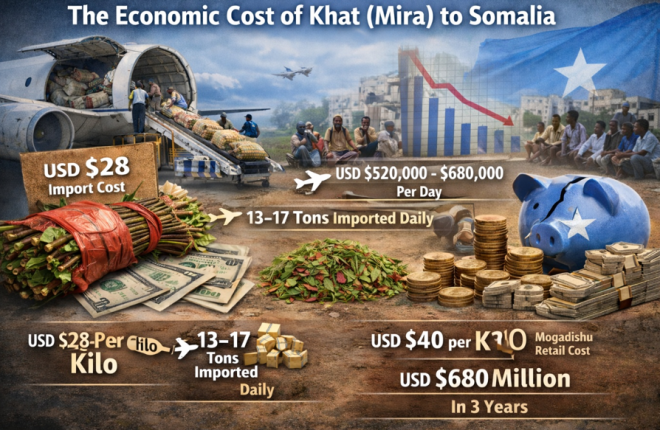
According to official Kenyan data, between 13 and 17 metric tonnes of mira are exported to Somalia daily, exclusively by air since July 2022, with Mogadishu Airport serving as the main entry point. Using Somalia-relevant pricing, each kilogram of mira costs USD 28 upon arrival in Mogadishu, before distribution to wholesale and retail markets. At this import price alone, Somalia spends between USD 364,000 and USD 476,000 every single day on mira imports.
Even using a conservative import-cost calculation, Somalia’s monthly expenditure on mira ranges from USD 10.9 to 14.3 million, and its annual spending from USD 131 million to USD 171 million. These figures exclude internal transport costs, retail markups, security-related expenses, health impacts, and productivity losses associated with prolonged khat consumption. When retail prices are accounted for, the actual economic cost to Somali society is substantially higher.
Kenya’s Ministry of Agriculture further reported that, since the reopening of the Somali market in July 2022, approximately 17 million kilograms of mira had been exported to Somalia by October 2025. At the import price of USD 28 per kilogram, this represents a cumulative Somali outflow of approximately USD 476 million over three years. Valued at Mogadishu’s retail price of USD 40 per kilogram, total Somali consumer expenditure over the same period rises to approximately USD 680 million.
The contrast is stark. While Kenya earns structured agricultural income—supported by public investment in infrastructure, research institutions, cooperative financing, and regulatory oversight—Somalia finances this trade almost entirely through private consumption, with no comparable reinvestment into domestic productive sectors. Kenya’s National Assembly proceedings underscore how mira revenues fund boreholes, market sheds, research institutes, and farmer cooperatives, illustrating how Somali consumption indirectly supports rural development in Kenya rather than investment, job creation, or public services in Somalia.
In economic terms, khat is not merely a social or public health concern for Somalia; it is a balance-of-payments issue and a structural drain on household welfare. The hundreds of millions of dollars spent annually on mira represent foregone investment in education, healthcare, infrastructure, and employment. As Somalia debates political reform, security transitions, and economic recovery, the scale of resources absorbed by khat consumption raises a critical question: Can a country struggling to rebuild its state and economy afford to sustain such a continuous financial outflow?
____________________________________
Mohamed Mukhtar Ibrahim, former minister of petroleum and minerals in Somalia, can be reached by email at [email protected]
This analysis is primarily based on official statements made by Kenya’s Cabinet Secretary for Agriculture and Livestock Development during the Kenya National Assembly proceedings on 3 December 2025.