
Post-Bulletin, Rochester MN
Saturday, May 31, 2008
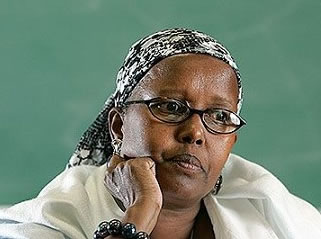 |
| A return trip to her native Somalia left a deep and sobering impression on Udbi Wallin of Rochester. Ken Klotzbach/Post-Bulletin |
This small refuge for the sick has been built thanks to the efforts of one Rochester woman -- Udbi Wallin. Amid reports of increased fighting in her homeland, Wallin returned in February to see conditions for herself. It was then she decided something needed to be done for the country's most vulnerable.
"Even if I can touch and make better one life, I feel like I'm not just sitting here enjoying myself and saying, 'Oh, I'm in America. They are in a mess. That's it,'" she said.
While stories about the humanitarian crisis in the Darfur region of Sudan have dominated media coverage about Africa, some Somalis in Rochester say their homeland is being forgotten. Local human rights groups estimate 6,500 civilians were killed last year in Mogadishu, victims of a political struggle between the interim government and militants called the Somalia Islamic Courts Council. The United Nations estimated 1 million Somalis have been displaced by the violence, and the threat of starvation is real.
Years of violence
Abdinur knows what it is like to have to flee violence. He left Somalia as teenager with his family when the Civil War broke out in 1991. For 17 years, the country has not had a centralized government. But the recent struggle has led to a surge in violence. Abdinur's grandmother and cousins still live in the country's capital of Mogadishu and have seen the fighting first hand.
"It's a very scary place for them. They don't know what is going to happen next," Abdinur said.
Abdinur, a journalist with Rochester Somali TV, said he believes the key to bringing peace to Somalia is international pressure.
"One of the major things that can help Somalia is the international community playing a huge role, way better than they are right now, by supporting the necessary peacekeeping troops we need," he said.
But, he said, the years of fighting in Somalia work against that.
"It's a forgotten country, where people just don't care anymore. It's too long of a struggle. Too long having fighting," he said.
Not to be forgotten
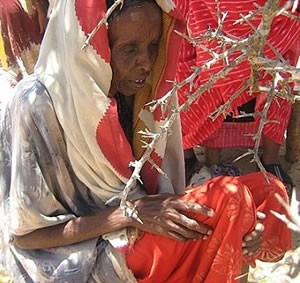 |
| This elderly blind woman was in a refugee camp outside of Mogadishu, Somalia. On this day, the woman had only had a cup of tea. /Photo submitted by Udbi Wallin |
"The cycle is starting right now," she said. "People are eating again just tree plants and animal skins and banana peels."
She is trying to do her part to help prevent that. In 2005, she founded a nonprofit group called Widow Farmers Hope Organization. A widow herself, Wallin purchased a farm near Mogadishu with donations from three Rochester women who want to remain anonymous. Widows and their children live on the farm and are taught sustainable farming practice, with the hope they will be able to support their families by growing vegetables and moringa trees. But the fighting has hurt those efforts.
"I was getting reports back from the widows that they did not harvest any vegetables last year because of the violence and the war, and the people who were selling the vegetables at the market had fled," she said.
So during a three-month visit to Somalia that ended last week, Wallin advised the widows to try to grow enough food to at least support their own families.
New project
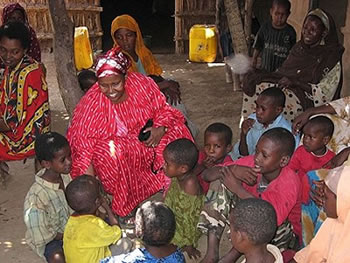 |
| Rochester resident Udbi Wallin visits with children who live on a farm she purchased in Sabid, Somalia. Widows and children live on the farm, where they are taught how to farm and provide for their families. /Photo submitted by Udbi Wallin |
It was there she saw an elderly man with prostate cancer and a catheter lying on a makeshift bed. For three months, he has been there with little protection from the scorching sun and the pouring rain and no medicine to ease his pain.
She decided she wanted to help people like him, teminally ill elderly patients with no one to care for them. So she launched the House of Mercy project with support of Rochester donors. The home is expected to open Monday to patients at the camp. To start, the home has only one staff person and provides food, shelter and sanitary conditions for the patients. Wallin is working with relief organizations hoping they will provide medical care.
To help her cause, Wallin has created a short documentary in English and Somali that shows the camp conditions. She said she hopes her efforts will inspire others, including her fellow Somalis, to do what they can to help.
"It's hard to be in Rochester. I feel guilty, but I'm not sitting here idle and enjoying my comfort and the peace and all the advantages and privileges this country offers," she said. "At least I'm trying to take risks."
How to help
House of Mercy
Contact Udbi Wallin at [email protected].
Source: Post-Bulltin, May 31, 2008